Thursday, 1 February 2018

Finally Did David and Solomon's Biblical United Monarchy Really Exist?


Kingdom of Israel: Finally Did David and Solomon's Biblical United Monarchy Really Exist?


According to the Bible, King David and his son, King Solomon, ruled a vast and powerful United Monarchy from 1050 B.C. to 930 B.C. So why is there no archaeological evidence of it?
As part of an ongoing series investigating the factual support for various parts of the Bible, Haaretz recently published a new article suggesting that in the absence of other, more conclusive evidence, one of the most promising points of support for the existence of the United Monarchy lies about 180 miles south of Jerusalem at Timna, the site of a wide-scale copper mining operation.
2218710824 King David's palace? Professor Eilat Mazar believes these are the ruins of King David's palace, found in the City of David, south of Temple Mount. Critics claim the dating of the ruins is uncertain. Haaretz/Avi Balaban
"Copper was the oil of the time and to control this region would have been a major asset,” Erez Ben-Yosef, a senior lecturer in archaeology at Tel Aviv University, told Haaretz. Ben-Yosef has spent 14 years excavating copper mining and smelting sites of Jordan and Israel.
Cyprus had largely cornered the copper market up until around 1200 B.C., when Mediterranean rule came to an end. By the time David and Solomon were in power, copper was sourced largely from the Aravah valley, the region in which Timna lies. Ben-Yosef told Haaretz that David and Solomon would have needed to control that source—for tools, weapons, and anything else they needed to run an empire.
Timna and the United Monarchy have been linked before. Ben-Yosef and his colleagues had even radiocarbon-dated animal dung that seemed to support the David and Solomon theory.
"We thought maybe some nomads had camped there with their goats a few decades ago,” Ben-Yosef told National Geographic News earlier this year. “But the [radiocarbon] dates came back from the lab, and they confirmed we were talking about donkeys and other livestock from the 10th century B.C. It was hard to believe.”
2252551546 The stepped stone structure (in the bible: Millo) in the City of David, Jerusalem, atop of which King David supposedly built his palace. Haaretz/City of David Foundation
Because the scale of the copper production was so massive, it stands to reason that a massive governing entity was around to support it. Everything from the volume of manual labor required to the complexity of trade arrangements needed to sell copper in such quantities points to a presence like the United Monarchy. And archaeologists studying the region have identified imported products, like bones, that date the copper production and supposed rules of David and Solomon to the same time. Ben-Yosef had already discovered an extensive textile collection in 2016, which he told Tel Aviv University was a first for that region.
"Any major power in the region would want to control the mines," Philip R. Davies, a biblical scholar and archaeologist at the University of Sheffield, told Haaretz. "I don't see that any of the small emerging kingdoms of the Levant could have secured control of this operation."
But that doesn’t necessarily mean that the major power was the United Monarchy. Skeptics have put forth viable explanations for who else could have controlled the mines besides David and Solomon. One popular theory is that Egyptians were in charge. Artifacts (as well as hieroglyphics) place them at the time and place, too. Davies told Haaretz that his money was on Egypt. And yet, more than one expert told Haaretz they believe that a large centralized power wasn’t necessary to run the mines at all. The miners themselves, known as Edomites, could have managed on their own.
2638365790 King David's palace? Professor Eilat Mazar believes these are the ruins of King David's palace, found in the City of David, south of Temple Mount. Haaretz/Avi Balaban
One potentially telling verse of the Bible described, in remarkably specific detail, Solomon constructing a temple with “a molten sea,” commonly understood to refer to copper.
"And he made a molten sea, ten cubits from the one brim to the other: it was round all about, and his height was five cubits: and a line of thirty cubits did compass it round about." (1 Kings 7:23)
"These descriptions do not make any sense on theological grounds," Gabriel Barkay, director of the Temple Mount Sifting Project, told Haaretz. "There is no reason to specify these technical details that basically are instructions to the contractor. This information has to come from some archive that is now lost."
The Haaretz investigation acknowledged that for the most part, the mystery of David and Solomon’s kingdom will never be solved.
“Apparently sometimes the Bible is right,” it concluded, “other bits have been distorted, and often we simply cannot know."

How You Can Be Creating Wealth Through God’s Way: How To Stop Being Poor and Tired

  • Will God make me prosperous and wealthy?
  • Why do people have money problems, even when they are serving God?
  • Why hasn't God answered my prayers to get out of debt?
  • Where does it say God will prosper me?
This article summarizes what the Bible says about money, wealth, riches and poverty.

The Bible Does not Promise Wealth

There is no promise in the Bible that being a Christian will lead to a good job,

But Do You Really Want To Become A Bitcoin Millionaire?


bitcoin
When you think of trading or investing, you probably think of stocks and bonds. You might also think of commodities, currencies and whatnot. But strolling into a mutual fund manager's office and mentioning Bitcoins would probably get you an odd look, assuming he or she is not an avid reader of TechCrunch.
Introduced in 2009, the electronic currency Bitcoin is exchanged through its own payment network. The Bitcoin can be stored in a virtual wallet and has been described as a cryptocurrency; a decentralized, peer-to-peer currency which relies on cryptography to facilitate currency generation and transactions. To prevent double-spending, computers known as “miners” receive transaction fees and free Bitcoins in exchange for running a proof-of-work system.
If you're just looking on how to invest in Bitcoins, sign up with Coinbase and get started. By using THIS LINK you'll get $10 in bitcoins after you buy $100 in Bitcoins.
If you don't like this idea –
check out Stockpile. You can buy fractional shares of Bitcoin using the fund GBTC. You get $5 for free by opening an account at Stockpile here.
Now, if you're looking to become a Bitcoin millionaire, keep reading.

“Do You Take Bitcoins?”

The Bitcoin is essentially a speculative vehicle for geeks. Basically, do not eat out and expect to pay for the meal with Bitcoins. Not long ago you could have bought illicit drugs with the currency, but the FBI closed down “Silk Road” earlier this year, which allowed people to buy illegal substances anonymously.
Some legitimate vendors have taken to Bitcoin, allowing customers to purchase real products and services with the digital currency. Richard Branson of the Virgin Group has even decided to accept Bitcoins through his Virgin Galactic. Reddit allows you to use Bitcoin to buy Reddit Gold.  Yes, you can't buy your everyday groceries with Bitcoins, but you can buy a trip to space. While some everyday vendors have looked into accepting Bitcoins too, most of the demand for the currency has been fueled by speculators, rather than early adopters.
If you're looking to use Bitcoin to pay for stuff, you need a Bitcoin wallet like Coinbase. It's a simple website/app that allows you to securely store your Bitcoins and sell them.
With so much volatility, using Bitcoins in everyday life would be extremely risky anyway. Buying a TV for $1,000 might have cost up to 10 Bitcoins last month and just one Bitcoin now. With such volatility, any serious commerce conducted with Bitcoins is likely to result in one party losing out on a lot of value. So right now, the cryptocurrency is realistically just a tool for speculation. Coinbase is one of the major Bitcoin exchanges, which allows you to buy and sell Bitcoins as you please. You sign up, deposit real-world money and exchange the currency with relatively low fees.

Bitcoin's Bullish History

First, let's take a look at the price history. According to Bitstamp, as of today the market capitalization is over $12B with over 12 million Bitcoins in the system. Until 2013, Bitcoins were trading for either less than $10 each or not much over. As soon as 2013 started, Bitcoins seemed to ever-increase in value until April 9 where they peaked at well over $200. By April 16, Bitcoins had lost almost half their value.
Since April, Bitcoins have made a ridiculous comeback. Bitstamp shows that the price of a Bitcoin didn't reach its previous peak until November this year. However, in this same month, Bitcoins surged up to well over $1,000 a piece.
Right now, they seem to be fluctuating. Of course this is all speculative. You can make all the predictions you want, but no one knows what the future holds for Bitcoin. Is it just a fad or could Bitcoin genuinely develop into an everyday currency? If it really took off, would the government not just ban it completely? Only time will tell, but for now let's speculate.
As of December 2017, the price of Bitcoin is past $18,000 – some people have made millions and billions investing in Bitcoin. Furthermore, there have been hard forks (i.e. splits) into things like Bitcoin Cash, which also have boosted people's profits.
Bitcoin Prices

How To Make A Million With Bitcoins

You have two options: mine or trade. By mining for Bitcoins, as long as the markets remain active you can basically make money for nothing. But the problem is, mining is such a tough gig now that it is hardly worth it. Turning your computer into a miner will likely make it noisy and heat up. It would likely take you a long time to even mine a single Bitcoin, by which time you probably would have spent more on electricity. However, if you have access to some serious computing power and you don't have to pay the bills, you could make some easy money here.
The more realistic way of making a million with Bitcoins is going to be trading them through the most prominent exchanges, such as Coinbase. Back in 2011, you could have bought Bitcoins for $10. Selling them at $1,000 today would have delivered a profit of $990 per Bitcoin. Basically you should have bought about 1,000 Bitcoins back when they were cheap. This would have cost you around $10,000 in 2011, making you a millionaire today.
Making a million with Bitcoins today is probably still possible, but you will need some capital. Bitcoins can fluctuate many percentage points every day (on May 22, 2017 the price jumped up 10%). Day trading Bitcoins is going to be risky, but where is there is volatility there is opportunity. Otherwise, you need to take a longer-term approach and conclude whether or not you think Bitcoin will be successful. If you think Bitcoin is going to be traded by foreign exchange dealers, market makers and institutions one day, you might want to go long. Buying right now would be incredibly risky; the price chart is screaming “bubble”, but your point of entry is up to you. Don't expect to see more of the same fast growth now though.
On the other hand, if you have a strong conviction in the downfall of the Bitcoin, you need to short the cryptocurrency in any way you can. This would be an extremely risky endeavor still, but if the Bitcoin market is truly destined for failure, why not get rich when the bubble pops? To short Bitcoin, you will either need to get creative or join an exchange which allows you to do so.

Other Ways To Invest In Bitcoin

It's important to remember that Bitcoin is a currency – not a stock or bond. This means that “investing” in it is like investing in a currency. You're essentially hoping the value of Bitcoin relative to your native currency goes up.
The easiest way to invest in Bitcoin is to simply get a Bitcoin wallet and buy Bitcoins. We recommend Coinbase for U.S. investors – it's the easiest, links to your bank account, and allows you to buy and sell Bitcoins. Plus, if you buy $100 USD in Bitcoins, Coinbase will give you a $10 bonus! That's awesome.
If you want to invest in an ETF through your broker, check out the GBTC at Stockpile. This ETF tracks Bitcoin, and you can invest in fractional shares. Get started at Stockpile and get $5 for free. Start here.
Remember, you could also invest in Litecoin or invest in Ethereum as well.

But What If I'm Sane?

If you are a sane individual, Bitcoins probably don't excite you too much. The risk/reward profile of the Bitcoin market is not going to be very appealing to the savvy investor. This is just a chance to either make a quick buck, or lose everything. Bitcoins may well take off in the real-world in the future, but then again what would stop another cryptocurrency from emerging and defeating the Bitcoin, especially if it was indeed better?
So in conclusion, if you want to be a Bitcoin millionaire, you need to hijack someone else's hardware and get mining for an extended period of time (and cash out before you get penalized or arrested). Failing that, you need to either day trade Bitcoins and take advantage of the short-term price volatility, or make an extremely risky long or short bet on the long-term success or demise of the Bitcoin.
By shorting, you might be able to make money on the downside in the short-term too if the so-called Bitcoin bubble is about to burst. On the other hand if you are sane, it's probably wise to just sit back and watch the chaos unfold.

The cryptocurrency called bitcoin is used all over internet and has become incredibly popular. Metro investigates if it's easy to get rich with it.

How to get rich with Bitcoin


bitcoin, bitcoins, get rich with bitcoin, make money with bitcoin
Is it possible to get rich with Bitcoin?

“I’ll pay 10,000 Bitcoin for two pizzas. Two large ones, so I’ll have something left for tomorrow,” Laszlo Hanyecz, one of the contributors to the digital payment system source codes, said before completing the bizarre trade in 2010. At the time of that offer, Bitcoins were quoted at $41.
It was the first documented purchase of a good with cryptocurrency. And if Laszlo would not have spent that 10,000 Bitcoins on pizza, in seven years they would have converted into $45.3 million.
How to buy Bitcoins?
Over the past years, the value of Bitcoins has exploded and constantly continues to grow. But is it a simple way to get rich really quick? I decided to follow Hanyecz’ example and invested two pizzas ($30) in Bitcoins. That isn’t very complicated.
First you have to create a digital ‘wallet’ and fill it with the cryptocurrency. I choose Copay, that has an easy app and can also be used on my laptop. It is easy to create a wallet just by typing e-mail address.
After that I had to copy a set of words. It is very important because if phone crashes, these will serve you as an only option to access the wallet. Otherwise, all your Bitcoins will be lost.
Now it’s time to buy a small piece of a Bitcoins. So, to invest $30, you have to go to"Bitcoin exchange" and make an anonymous purchase – it works if the total amount does not exceed $60.
I submit the amount and my address (it’s important not to make any typos, otherwise you will lose money) and within a few minutes, 0.008142 Bitcoins are on my account. Remember that transactions cost around $1.4.
And the price goes up!
Now I have to wait for the prices to rise. However, I may not have entered at the best moment. The rate at this point is around the $4.1k and has never been higher than today. But the Bitcoin is breaking one record after another, so why won’t that continue during the next couple of days?
But several days after the rate declines, and I start to be worried. Fortunately, it’s just $30 and if it does not make me rich, the damage is still limited.
Soon Bitcoin’s price is rising again. In a week, there’s suddenly almost $36 in my account. A yield of about 20 percent. In just one week!
I am proudly telling everyone about my talents in investing. But it has nothing to do with that, as Leon Brandsema, a financial expert, explains.
“After this good profit, it only seems like you have control over it, as if you entered the market at the right time because of the good insight,” Brandsema says. “However the Bitcoin rate is based on nothing. I can’t think of any reason why it shouldn’t be worth 1 dollar, or 1 million dollars.”
Brandsema compares it with a house: “For example, house is really worth something. It’s made of building materials, you can live in it. There’s nothing behind Bitcoin that represents that value.”
He adds: “The only reason why Bitcoin is worth so much, is because there’s a lot of demand for it. You have a yield of 20 per cent in a week. That doesn’t happen on the normal stock market. But because of that the rate may collapse suddenly tomorrow.”
Pizza, then…
So, I’m not such a smart, successful investor. Maybe it’s best to take our my profits as soon as possible. But how to get rid of my Bitcoins? For example, I can resell them to an intermediary office called Bitonic. But better I’ll follow Lazlo Hanyecz’ example. I’ll buy pizza from it.
At Thuisbezorgd.nl you can pay for it with Bitcoins. But almost no one accepts the cryptocurrency, as spokesperson says.
Nevertheless, paying is a piece of cake. I choose my pizza and select that I want to pay with Bitcoin. After that, I get a QR code on my screen. I scan it with my wallet app and confirm the order. Pizzas are on their way.
Now I can only hope that they will not turn out to be worth more than $45 million in seven years.

How to be mega rich trading Bitcoin


Bitcoin exchange Bitstamp suffers $5 million hack attack
As an observer of the Bitcoin market as long as this original cryptocurrency has existed, it never made much sense to me from an investment perspective. Bitcoin prices were too volatile and the volatility seemed too random. Volatility can be a good thing for traders, mind you, but only if you think you have an idea why the price goes up and down the way it does. Otherwise it is just a good way to lose all your money. But a couple of recent events have changed my view of Bitcoin. I now think I can explain its volatility and predict it well enough for profitable trading. And the best part is that it takes no rocket science at all. Your mother (and mine) can make a living trading Bitcoins.
For those who don’t know, Bitcoin is a stateless currency based on blockchain calculations. There will only ever be 21 million Bitcoins and only 16-odd million of those have so far been "mined." The present value of all mined Bitcoins is around $18 billion, which is amazing if you realize they came from nowhere and have no intrinsic value.
My first realization about Bitcoins this year came among the annual predictions I publish every January. Here’s what I wrote then:

Not the demise of Bitcoin, but finally an acceptance of what the crypto currency is (and isn’t). My son Cole, who is 12 (and now taller than me), was for awhile a Bitcoin miner. We bought a used Ant Miner last year on eBay, equipped it with a proper power supply and set it going 24/7 in the Man Cave, where most boyish things happen around here. The rig was incredibly loud and -- after the first electric bill arrived -- totally uneconomic. We were paying twice as much for electrons as Cole was receiving in Bitcoins for his labor. Anyone with a robust solar installation want to buy an Ant Miner?
Then a few weeks ago Bitcoin prices started to rise again and I saw Bitcoin stories with headlines like "Too Big to Fail." Yet what goes up seems to inevitably come down because Bitcoin prices crashed yet again a few days ago. This led me to a realization that I think is going to become popular: Bitcoin is an excellent transfer currency but as a longer term store of value it sucks and that isn’t likely to change.
Bitcoin is a great idea, blockchain is an even better idea, but since neither is backed by the full faith and credit of, well, anyone, a Bitcoin will always be a sorry substitute for a dollar or a yen. The price of Bitcoins will rise as folks in China find the need to use them to get money out of that country. But when their money finally is out of the China it is inevitably converted straight into dollars and the Bitcoin crashes as a result. So there may be some cyclical arbitrage opportunity in Bitcoins, timing the market to take advantage of the suckers, but as a true currency, Bitcoin will probably never cut it.
This says nothing about technical merit, mind you. What matters here is psychology and behavior. It’s the "full faith and credit" thing. Without it Bitcoin can’t be trusted to be any more than a short-term monetary value mule.
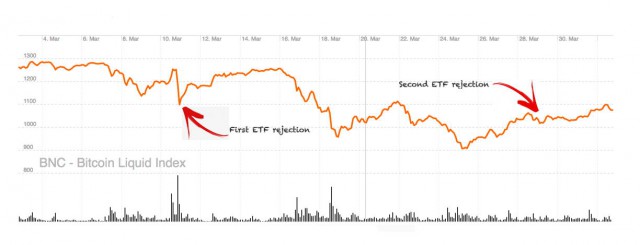
My second Bitcoin realization came last month when the SEC denied two separate proposals to create Bitcoin-based Exchange Traded Funds (ETFs). The SEC’s reason for the denials doesn’t matter here but it’s likely to stick even under President Trump, so don’t expect that situation to change. Bitcoin ETFs would have ballooned the currency’s capitalization as little investors piled-in like timeshare condo buyers. It would have been an easy win for those with large existing Bitcoin holdings like the Winklevoss twins, who were behind the first ETF proposal to go down in flames.
BIX-ETF-response (1)
Upon the news, Bitcoin dropped in price by 25 percent then recovered completely within two days! When the second ETF application was denied the drop was much smaller and the recovery even quicker. Some will say the market had already priced-in the SEC decision, but that begs the question of not why Bitcoin didn’t go down by much, but why it quickly continued to rise? This is what I think I’ve figured out.
I’m starting to believe Bitcoin can’t go down in value. I mean, it will be volatile of course and there will be many bumps in the road. But over time, it’s a good bet that it will continue to rise in value as the most popular cryptocurrency. If it loses that status then fine, it can go down, but something is going to win here and Bitcoin is the prime contender.
The first reason I say this is because there are two kinds of Bitcoin owners.
First are those poor sods who think it’s a store of value and the price will go up for unknown reasons. These folks are much like stockholders. There are only a finite number of shares of a given stock. When I buy one I slightly make the price go up. If I hold that share, I also ever so slightly put upward pressure on the stock price because my one share is not available for sale. Obviously, I’m (slightly) limiting supply.
Unlike stocks, however, there’s another kind of Bitcoin owner -- one who owns the currency only for a few seconds. You can spend Bitcoin at Dell (and lots of other places) to buy computers. Now what really happens is that I can convert Fiat currency to Bitcoin, send it to Dell (For the nice minimal transaction costs) and Dell instantaneously turns it back into Fiat. Dell and I hardly cared about Bitcoin: it was (as I explained in my annual predictions) a transfer mechanism, not a store of value.
Dell and I were Bitcoin owners for only a fraction of a second, but we were owners. We did indeed “limit supply” of Bitcoin for a very short time.
Amazingly, Dell and I were utterly insensitive to Bitcoin’s price. All we want is non-volatility for the few seconds we owned it. I don’t care if a Bitcoin is worth a dollar, a thousand dollars or a million dollars. I’ll buy the exact number of Bitcoins (or fractional bitcoins), send them to Dell, and they’ll turn them back into Fiat. As long as the USD to Bitcoin exchange rate remains relatively stable in that tiny timeframe, we accomplished our value transfer.
Realization number three -- Bitcoin transactions are increasing.
That is, more and more Bitcoins are being owned for fractional seconds. At some point enough transactions (especially big ones) mean a lot of Bitcoin is out of the supply pool tied up in transactions. Bitcoin gets harder to find if even for a few seconds. Hence you have to convince more people from the first type of owners (the stored value holders) to sell their Bitcoins back into the supply, driving prices up.
Bitcoin is having some high-transaction issues which might cause a technical downfall from what I describe, but in general, whichever cryptocurrency wins will end up ever-increasing in value because of a finite money supply and the scarcity of money itself!
That’s the micro view, now let’s look at the macro view of the same market. As I wrote in my prediction, a large part of the Bitcoin market -- the really big transactions -- are rich people in countries with capital transfer controls using Bitcoins to get parts of their fortunes out of Dodge and into some safer economy. There are lots of such countries and -- this is the important part -- there will always be lots of such countries. So whether it’s a Chinese cabinet minister or a Russian oligarch or someone from behind Door Number Three, there will always be some rich person trying to move a shiftload of money to safer ground.
This suggests my new Bitcoin trading strategy, which I admit I have only tried so far on paper. Here’s how it works. Bitcoins go down in value when the demand for them as transaction instruments decreases. When that Russian oligarch sells his shiftload of Bitcoins for US dollars, Bitcoin value goes down. When that happens -- when Bitcoin prices drop by 20 percent or more -- BUY! The price will inevitably come back up, I assure you.
When Bitcoin prices rise by 20 percent or more -- SELL! You just made 40 percent on your money.
Rinse, repeat, automate, get rich.
Nothing short of some other cryptocurrency taking the business from Bitcoin is going to change this trend. Say Goldman Sachs throws billions into doing exactly as I propose but as an institution. That will drive Bitcoin values generally higher and decrease price volatility a little, but the general trend will continue. So lower your threshold to +/- 10 percent (instead of 20) and do twice as many transactions.
The success of this strategy comes, I think, from the limited supply of Bitcoins. With only 16 million in circulation and only 21 million EVER, there will always be price changes with larger transactions, which is to say there will always be profit opportunities. I wonder if this was part of the Bitcoin plan from the beginning?
Another growing cryptocurrency is called Ripple and it was designed, frankly, to avoid these very profit opportunities. There are 100 billion Ripples, for example, compared to 16 million Bitcoins. But then Ripple is aimed straight at inter-bank transfers while Bitcoin has to be aimed, I’m guessing, straight at those who prefer to avoid banks altogether, at least for transactions like these. Bitcoin is the Wild West cryptocurrency.
Now for the paper test of my trading strategy. Using the interactive Bitcoin historical daily price chart at 99bitcoins.com, I started my paper test by converting $100 to Bitcoins on July 17, 2010 -- the first day Bitcoins were ever traded -- when the price was $0.05. I then scrubbed through the data looking for selling and buying opportunities that more or less met my +/- 20 percent guideline.
This is neither an optimal nor a perfect trading strategy and it misses a lot of profit opportunities, but is easy to automate. For example there are times when the sell signal is just a hiccough and the price keeps going right on up (or down), but I’ve already sold (or bought). In some instances there are almost daily trades while in two cases I went more than a year without doing anything because my criteria weren’t met. In all, there were 31 total transactions, with my last SELL order on February 2, 2017 at $990.65 for a total value of $21,638.88. A BUY order followed on March 26, 2017 and prices are generally higher since, but I’ll stand on growing $100 to $21,638.88 (almost a 220X profit) in about 6.5 years.
In contrast the S&P 500 grew by 2X (from 1100 to 2300) in the same period.
But maybe my huge Bitcoin paper trading success had to do with starting at the very beginning when a Bitcoin was worth only a nickel, which will never happen again. This is a mid- to long-range trading strategy I’m proposing, but if it has any real value that should be visible in a couple years, so I went back to the 99bitcoins chart and did the same analysis starting a year later, then two years, three years and four years later. I also did the analysis beginning when Bitcoin first hit $10, $100 and $1000.
Starting with $100 in July 2011 my paper trades grew to 1,056.26 in 5.5 years for a 10X return.
Starting with $100 in July 2012 my paper trades grew to 2,020.99 in 4.5 years for a 20X return.
Starting with $100 in July 2013 my paper trades grew to 289.81 in 3.5 years for just under a 3X return.
Starting with $100 in July 2014 my paper trades grew to 183.41 in 2.5 years for a 1.8X return.
Starting with $100 when Bitcoin first reached $10 in June, 2011 my paper trades grew to $1532.01 in 5.5 years for a 15X return.
Starting with $100 when Bitcoin first reached $100 in April, 2013 my paper trades grew to $505.82 in 3.75 years for a 5X return.
Starting with $100 when Bitcoin first reached $1000 in December, 2013 (a true moment of irrational market exuberance) my paper trades didn’t really grow at all in four years but at current prices I’d get my money back.
So in all scenarios except one, my paper returns clobbered the S&P 500 and in that one exception, though I didn’t make any money, I didn’t lose any, either, other than opportunity cost.
Since I’m known as an economics blogger of sorts (the Kauffman Foundation has declared me several times to be one of the top US economics bloggers), but I’ve never before proposed a trading strategy, I thought I’d reach out for some adult supervision. So I showed a draft of this column to Darrell Duffie, Dean Witter Professor of Finance at the Stanford Graduate School of Business and a friend of mine for 30+ years. Here’s what Darrell had to say more succinctly than I ever could:
"On the substance, you are proposing that there is mean reversion in the price of Bitcoin through the effect of price impacts caused by big transactions. This happens a lot in other financial instruments. I don’t know whether this is a correct diagnosis in the case of Bitcoin price behavior, but I would not rule it out. It seems reasonable."

Why United States defends role of Lebanon army as Israel threatens to attack it


Acting U.S. Assistant Secretary of State for Near Eastern Affairs, David Satterfield, speaks during the 11th Annual International Institute for National Security Studies (INSS) Conference in Tel Aviv, Israel January 31, 2018. REUTERS/Amir Cohen
By Dan Williams
TEL AVIV (Reuters) - The United States pledged continued support for Lebanon's military on Wednesday, calling it a potential counterweight to Iranian-backed Hezbollah, even as Israel said the two forces were indistinguishable and fair game in any future war.
Such a public difference of opinion between the allies was remarkable enough, but especially so as it was sounded by senior officials at the same event - an Israeli security conference.
The Lebanese Armed Forces took no part in the 2006 war between Hezbollah and Israel. It has received more than $1.5 billion in U.S. military assistance since then and, in the last seven years, training and support from U.S. special forces too.
"We will sustain our efforts to support legitimate state security institutions in Lebanon, such as the Lebanese Armed Forces, which is the only legitimate force in Lebanon," David Satterfield, acting assistant U.S. secretary of state, told the conference organized by Tel Aviv University's INSS think-tank.
Satterfield added that the Lebanese army "could well serve as a counterweight to Hezbollah's desire to expand its own influence there, as well as Iran's reach in Lebanon".
But taking the stage three hours later, Israeli Defence Minister Avigdor Lieberman reiterated his view that the Lebanese army was under the command of the better-equipped Hezbollah.
"As far as I'm concerned, all of Lebanon - the Lebanese army, Lebanon and the Lebanese army - are no different from Hezbollah," he said. "They are part of Hezbollah and they will all pay the full price" for any large-scale attack on Israel.
There was no immediate response from Hezbollah or the Lebanese military.
The Lebanese military has previously said it operates independently from Hezbollah, most recently during an operation against Islamic State at the Lebanese-Syrian border last year.
Israeli intelligence officials told Reuters last year that they believed the Lebanese army maintained autonomy even if some of its personnel cooperated with Hezbollah.
The INSS conference coincided with heightened concern in Israel about what it describes as Iranian efforts to fit precision-guidance systems onto Hezbollah's longer-range missiles. Such improvements could potentially allow Hezbollah to knock out key Israeli infrastructure.
Washington shares these worries, according to Nathan Sales, the State Department's coordinator for counterterrorism.
"We're very concerned about Hezbollah developing an indigenous weapons manufacturing capability or alteration capability inside Lebanon," Sales told Reuters at the conference.
He declined to comment on how far advanced such missile projects might be, but said the United States was trying to hinder them and other Hezbollah capabilities by using sanctions to dent the $700 million that Iran gives the militia annually.
Neither Hezbollah nor Iran has responded to such charges.
Israel has also been lobbying Russia - which has some sway over Iran and Hezbollah because of their alliance in Syria. Israeli officials said they hosted a senior Russian security delegation on Wednesday, with the missile issue on the agenda.

"The kryptonite that can weaken North Korea is information from beyond its borders," Blair said in a written testimony to the Senate Armed Services Committee. North Koreans have no idea how bad things are in their country, Blair said, because they're subject to an "unrelenting barrage of government propaganda."

Former US intelligence chief reveals North Korea's 'kryptonite' — and it could topple Kim Jong Un without a shot

Kim Jong Un Kim Jong Un's government relies on control of information, but the US could take that away. KCNA / via REUTERS
  • A former head of the US intelligence community described what he called North Korea's "kryptonite,"